Introduction to Asset Management
This article is aimed at engineers, asset managers, and maintenance managers directly involved in power transformer reliability and the assessment of their condition during the End-of-Life (EoL) stage.
One of the critical factors—if not the most important one—is determining the point at which transformer aging becomes critical, increasing the risk of a catastrophic failure when subjected to external stress events.
By having this information, the Asset Management and Maintenance departments will have the necessary lead time to evaluate different alternatives and ultimately make a decision regarding the reconditioning or replacement of the transformer, as well as the adaptation of condition monitoring systems and the development of contingency plans.
Therefore, the objective of this work is to provide the relevant sectors with all the necessary information for decision-making, enabling the establishment of a Contingency Plan for a transformer (or several) that is approaching its End-of-Life stage.
Expected Life and Planning
Within the lifecycle management of a power transformer, the most complex decisions for Asset, Maintenance, and Operations management are undoubtedly those associated with the End-of-Life stage.
In this regard, and in order to evaluate the characteristic conditions of this stage, the concept of Expected Life emerges.
It is defined as the time elapsed from the beginning of the transformer’s operational life to the point in time when the basic periodic maintenance system must be changed or adapted to another one that addresses the characteristic conditions of the end-of-life stage.
Furthermore, during this stage, Reconditioning and Replacement/Disposal Plans for the transformer must be formalized or redefined.
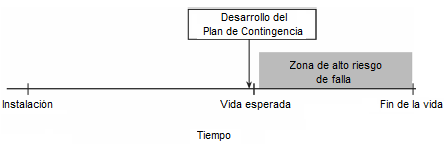
Figure No. 1
Lifecycle Timeline and Risk Management
Figure No. 1 illustrates the timeline, highlighting the characteristic states of the transformer’s lifecycle. The interval between the Expected Life and the End-of-Life (EoL) represents the EoL stage of the cycle. It is worth noting that during this stage, the transformer will have an associated high probability of failure risk due to the combined effect of aging and system events.
Therefore, the Contingency Plan must provide for all maintenance actions necessary to ensure the transformer continues to fulfill its functions, as well as evaluate measures to extend its useful life (operation and maintenance). Furthermore, it must develop and formalize the associated Reconditioning and/or Replacement/Final Disposal plans to be executed when the transformer reaches the end of its life.
These plans must be integrated and aligned with the organization’s Finance department, as they involve economic and financial decisions closely tied to the transformer’s obsolescence.
The key to estimating a transformer’s expected life lies in establishing the means to avoid or limit the consequential effects of a catastrophic failure resulting from degradation processes that cannot be detected through the maintenance protocols implemented during the Expected Life stage.
If your asset management strategy projects equipment replacement, explore the efficiency and reliability of Miron oil-immersed transformers.
Obsolescence and Financial Decisions
The End-of-Life stage of a transformer must be considered critical because, from an Asset Management perspective, it involves a significant increase in associated risks and lifecycle costs, along with a decrease in the machine’s operational performance within the system.
A crucial factor to consider is that during the EoL stage, integration and alignment with the organization’s Finance department is key to determining the costs associated with obsolescence analysis, as well as the costs of the technical solutions to be implemented.
In line with this, a primary objective of Asset Management is to execute processes that minimize costs throughout the transformer’s entire lifecycle. This vision includes operation, maintenance, and the replacement/disposal of transformers within the End-of-Life stage.
Considerations:
- Optimal replacement/disposal timing: Will lead to lower costs for both the community and the organization.
- Delaying the replacement/disposal decision: Will lead to increased maintenance costs and further deterioration of the transformer.
- Premature replacement/disposal: Will result in the community and the organization not fully capturing the value of the transformer.
If your analysis favors replacement with high-efficiency and high-safety equipment, discover our solutions in Miron dry-type transformers.
For certain specific problems during the End-of-Life stage, it is necessary to take the transformer out of service to perform internal inspections. Consequently, for some types of issues, it will also be necessary to remove the transformer from its site to transport it to a repair workshop.
The expected life indicator serves as a tool to assist in the planning and development of Asset Management during the End-of-Life stage, as well as in determining the need for additional condition monitoring technologies beyond those already installed during the Expected Life stage.
