What are polarization and absorption indices for?
Polarization rates and absorption rate are two parameters that give us an idea of how damaged a winding’s insulator is.
Although this index is widely used today, it is not included in the tests provided for in transformer manufacturing standards. Its application lies mainly on transformers (or motors) that have already been used, have been repaired or new that have been idle for long periods. Although these indices are frequently used today, it should be clarified that they are not included in the tests provided for in transformer manufacturing standards. The application of these is mainly on transformers (or motors) that have already been used or repaired, as well as on new equipment that has been idle for long periods.
This index is contained within the IRAM 2325 Electrical Insulation Standard, which states:
Electrical Insulation Regulations IRAM 2325 | Excerpt
“The dielectric properties of insulating materials used in electrical equipment (motors, transformers, etc.) are progressively degraded during their use. This is due to a natural aging process caused by the passage of time. However, this degradation process can be accentuated, even to the point of causing insulation failure, by one or more of the following causes:
- Excessive heating or cooling
- Mechanical damage
- Vibrations
- Dust, dirt, etc.
- Oils
- Corrosive fumes and fumes
- Moisture from industrial processes
- Humidity of the environment.
These elements, in combination with the dielectric stresses, are the cause of the deterioration of the insulating characteristics of the insulation of the equipment, either due to their presence during service, or due to defects in the manufacture or repair of the new or refurbished equipment, respectively, or in its maintenance.
Insulation resistance measurements are, within this context, the most appropriate methodology for the quick, simple and economical evaluation of the state of the insulation of a piece of equipment.”
What is the Polarization Index (PI)?
The Polarization Index (PI) is the ratio of the insulation resistance measured at 1 minute to 10 minutes after a continuous test voltage is applied.
IP = R10min/R1min
This ratio (IP) results in a dimensionless value, and represents a state of the characteristics of the insulators of the measured equipment, especially in particular, it fulfills the function of evaluating the state of humidity and cleanliness of the machine.
The indication of the IP value reveals the state of the ground insulation of the equipment evaluated, this is because after a DC voltage has been applied, and after a long period of time has elapsed, the absorption current of the insulators should be reduced until, if the insulator is in optimal conditions, this current should be cancelled, giving an ideal resistance value that tends to ∞.
It is to be expected then that a low value of the polarization index will indicate that there is a high conduction or leakage current, caused by damage to the insulation, dirt, humidity, etc.
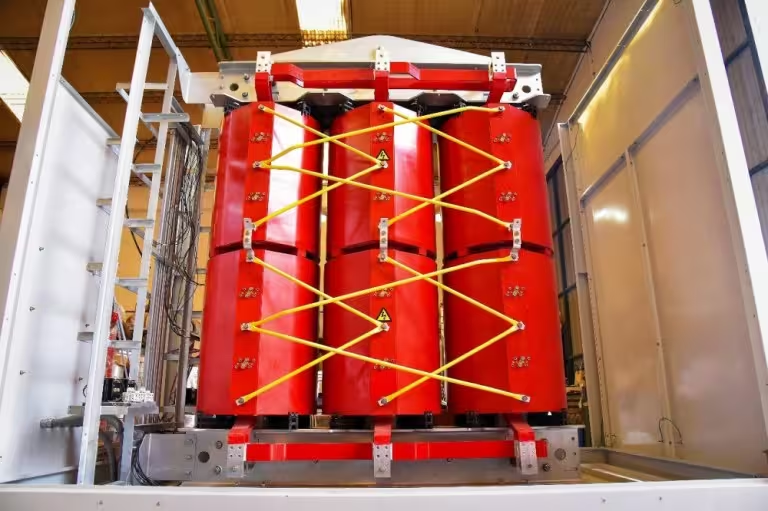
In certain cases, where the equipment to be evaluated uses modern insulating resins or dry insulations (dry transformers), the absorption current can be brought close to zero within two to three minutes from the start of the test.
Because of this, there is a variant of the polarization index, called the Dielectric Absorption Ratio (RAD).
What is the Dialectical Absorption Ratio (RAD)?
This relationship evaluates the insulation resistances at 60 seconds and 30 seconds after starting the test. The relationship between the two values is the so-called RAD:
RAD = R60sec/R30sec
The measured insulation resistance values must be corrected, depending on the ambient temperature, to bring them all to 20ºC.
The correction values should be obtained from Figures 2A and 2B of the IRAM 2325 Standard.
However, the values obtained for resistance do not need to be corrected if they are to be evaluated only to obtain IP or RAD.
| Dielectric Absorption Ratio | Polarization Index | Insulation Status Rating |
| RAD < 1.1 | IP < 1 | Dangerous |
| 1.1 < RAD ≤ 1.25 | IP < 1.5 | Questionable |
| 1.25 < RAD ≤1.4 | 1.5 ≤ IP < 2 | Acceptable |
| 1.4 < RAD ≤ 1.6 | 2 ≤ IP < 3 | Good |
| 1.6 < RAD | 3 ≤ IP < 4 | Very good |
| 4 IP ≤ | Excellent |
The DC Voltage values to be applied for the measurement of the Insulation Resistance are given in the IRAM 2325 Standard, and are summarized below:
| Nominal Alternating Voltage of the Equipment “Un” | Test DC Voltage “E” |
| V | V |
| Un ≤ 110 | 100 and 250 |
| 110 < Un ≤ 660 | 500 to 1000 |
| 660 < Un ≤ 1000 | 500 to 2500 |
| 1000 < Un ≤ 3300 | 1000 to 5000 |
| 3300 ≤ Un | 2500 Emax (*) |
(*) Emax = 1.3xUe for unused equipment.
Emax = 0.95xUe for used equipment.
Ue = RMS of the test alternating voltage at short-duration industrial frequency (applied voltage), prescribed for unused equipment.
Considerations to take into account when measuring
In the case of very old machines (more than 20 years old), a high value of the polarization index, for example, in the order of 5 or higher, can be a symptom of dry and brittle insulation.
Regarding the polarization index test, it should be taken into account that, if an insulation resistance test has previously been carried out, with a result greater than 5 MΩ, the value of the measured current is in the order of microamperes. With these values, small variations in the supply voltage, ambient humidity, stability of contacts and connections, etc., can significantly affect the measurement and, if the polarization index value is used as a decision criterion in this case, can lead to errors.
Frequently asked questions about the polarization index
What can I do to improve the polarization index?
As mentioned at the beginning, being an index of the state of humidity and cleanliness, if the winding is cleaned and dried, it improves significantly.
What does a low polarization index mean?
A low IP (<1) indicates leakage currents from moisture, dirt, or insulation damage, requiring urgent maintenance.
How to choose dry insulation transformers?
Look for certified equipment that complies with standards such as IRAM 2325 and offers high dielectric strength, such as those from Miron.
Optimize your maintenance with dry-insulated transformers
The bias index and the Dielectric Absorption Ratio are key tools to ensure the reliability of transformers and motors, according to the IRAM 2325 standard. These measurements help prevent costly failures caused by moisture, dirt, or aging. Dry isolation transformers offer a robust and efficient solution for demanding environments. Do you want to ensure the maximum durability of your equipment? Explore Miron’s dry isolation transformers and get a quote today.
