Why look for energy efficiency?
The Kyoto Protocol, initially introduced in 1997, seeks to reduce greenhouse gas emissions, which represent one of the causes of global warming. Although this protocol was established in 1997, its entry into force was not until 2005.
It seeks to put into practice what was agreed in the United Nations macro convention on “Climate Change”. In this case, the 38 most industrialized countries and the European Union commit to reducing greenhouse gas emissions, which are one of the most important causes of global warming.
The main Greenhouse Gases
- Carbon Dioxide
- Methane
- Nitrous Oxide
- Hydrofluorocarbons
- Perfluorocarbons
- Sulphur Hexafluoride
Of all those named, carbon dioxide (CO2) is by far the most abundant and the one that has grown the most since the industrial revolution. It is obtained by burning fossil fuels in energy activities (refineries, coke plants and combustion facilities), as well as in the production and transformation of ferrous metals, mineral industries (cement, glass and ceramics) and manufacture of paper and paper pulp.
Energy efficiency in transformers
Focusing on this protocol and seeking to reduce the emission of CO2 into the environment, the European community established Directive 2009/125/EC in 2009. In the first instance, it was based on energy efficiency in power plants, but then it was expanded to energy-related products, where it introduces transformers.
In accordance with this directive, EU regulation 548/2014 was carried out, where, based on the studies carried out by the European Commission, the new ecodesign guidelines that must be adopted by transformers were established.
The purpose of this regulation is to improve the performance of the equipment, producing greater energy savings, and therefore reducing the emission of Greenhouse Gases (CO2), due to a better use of the energy generated.
Stages of energy efficiency in transformers
This improvement in the efficiency of transformers consists of 2 stages; the first stage since July 2015 and the second since July 2021.
In the case of medium-power dry transformers, the first stage reduces no-load losses by approximately 30%, and load losses by 10%. As for the second stage, the reduction in empty losses is another 10%, and those due to load in some cases is 12% (compared to the previous stage).
Below is the table of values established in the EU/548 standard for medium-power dry transformers.
| Allocated Power | 1st Stage (July 2015) | 2nd Stage (July 2021) | ||
| Maximum Losses | Maximum Losses | |||
| Charging | Vacuum | Charging | Vacuum | |
| kVA | W | W | W | W |
| 50 | 1700 | 200 | 1500 | 180 |
| 100 | 2050 | 280 | 1800 | 252 |
| 160 | 2900 | 400 | 2600 | 360 |
| 250 | 3800 | 520 | 3400 | 468 |
| 400 | 5500 | 750 | 4500 | 675 |
| 630 | 7600 | 1100 | 7100 | 990 |
| 800 | 8000 | 1300 | 8000 | 1170 |
| 1000 | 9000 | 1550 | 9000 | 1395 |
| 1250 | 11000 | 1800 | 11000 | 1620 |
| 1600 | 13000 | 2200 | 13000 | 1980 |
| 2000 | 16000 | 2600 | 16000 | 2340 |
| 2500 | 19000 | 3100 | 19000 | 2790 |
| 3150 | 22000 | 3800 | 22000 | 3420 |
New energy-efficient transformer “Eco CAT”
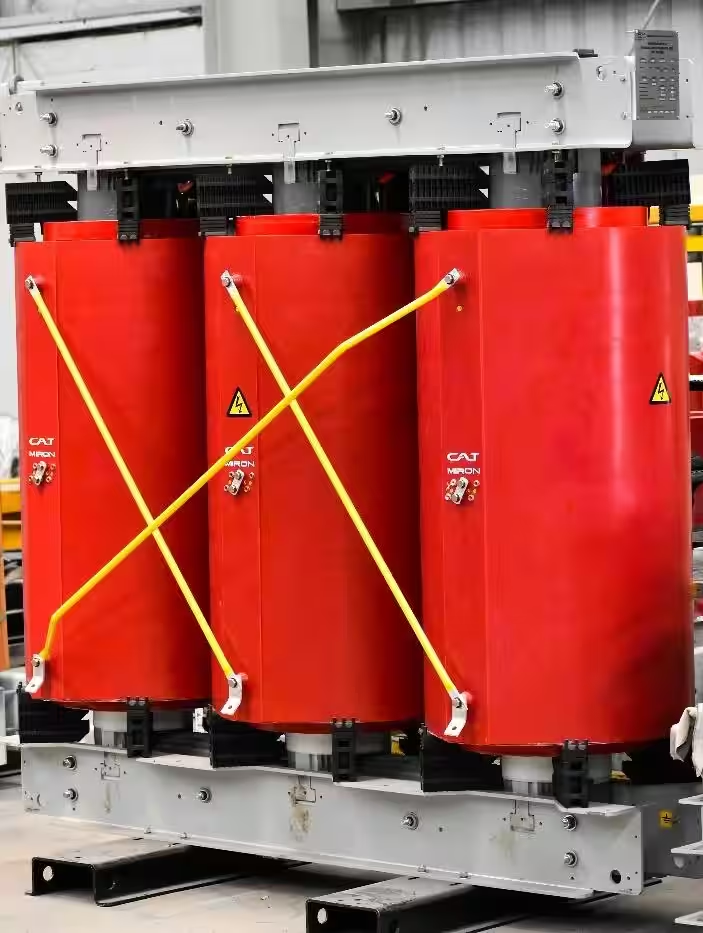
With the aim of meeting these new challenges, seeking to be more responsible in caring for the environment and in accordance with the guidelines established in the current regulations for the first stage of implementation, CAT MIRON has launched its new line of “Eco CAT” Transformers on the market. This was achieved thanks to a process of continuous improvement in the design and manufacture of its products, accompanied by a constant search for better raw materials.
With this new line of “Eco CAT” transformers (already available on the market) it is possible to reduce losses compared to standardized transformers (IRAM 2277 Standard) in:
| Insulation Level 17.5kV | ||||
|---|---|---|---|---|
| Power | Loss Reduction | |||
| Vacuum | Charging | Totals | ||
| kVA | W | W | W | % |
| 100 | 160 | 20 | 180 | 7.2 |
| 125 | 180 | 10 | 190 | 6.8 |
| 160 | 230 | -140 | 90 | 2.7 |
| 200 | 270 | 30 | 300 | 7.6 |
| 250 | 340 | -5 | 335 | 7.2 |
| 315 | 380 | 220 | 600 | 10.7 |
| 400 | 450 | 20 | 470 | 7.0 |
| 500 | 500 | 375 | 875 | 11.0 |
| 630 | 550 | 335 | 885 | 9.2 |
| 800 | 700 | 1430 | 2130 | 18.6 |
| 1000 | 750 | 2040 | 2790 | 20.9 |
| 1250 | 1000 | 2340 | 3340 | 20.7 |
| 1600 | 900 | 3100 | 4000 | 20.8 |
| 2000 | 1350 | 3205 | 4555 | 19.7 |
| 2500 | 1400 | 2850 | 4250 | 16.1 |
| 3150 | 1700 | 4450 | 6150 | 19.2 |
The comparison in the table above is made based on the losses of the transformers standardized in IRAM 2277 with respect to the Eco CAT guidelines (UE/548), for step-down transformers with a ratio of 13.2/0.4kV.
With the reductions in losses in transformers, it is not only possible to reduce the emission of CO2 into the environment, but also to obtain a significant reduction in operating costs.
The operating costs in the service linked to the transformers depend exclusively on the energy losses that the transformer generates.
Energy losses generated by transformers
Empty losses; they are dependent on the magnetic induction of the iron core, and on its physical and constructive characteristics. These losses will be present at all times that the transformer is connected to the grid. And its value for equipment that has already been built will only change if magnetic induction is modified, i.e. if the transformer is supplied at a voltage or frequency different from the one designed. Keep in mind that it is not recommended that a transformer be supplied with a voltage or frequency different from the nominal values, and that the small deviations that may appear in them are of the maximum order of 5%; Deviations from the permissible nominal voltage value are stipulated in the respective manufacturing standards.
Load (or short-circuit) losses; these are the losses that occur when current flows through the windings due to feeding a load in the secondary circuit. The value obtained is a quadratic function of the transformer’s state of charge, i.e. at full load, the maximum guaranteed losses will be present, but when the state of charge is 50%, the short-circuit losses are reduced to 25% of the maximum value. Although in laboratory measurements these losses can be individualized, in practice, they will be added to the vacuum losses.
From what has been expressed in the previous points, it is understood that the savings in the cost of energy can be evaluated in several different situations, depending on the state of charge of the transformer to be evaluated.
Below, as an example for 4 different cases, the reduction of energy consumption in a 1000kVA transformer of 13.2kV/0.4kV Eco CAT power, with respect to the same, but with the losses indicated according to the IRAM 2277 standard.
Case 1: Transformer connected to the grid without delivering power to the secondary (vacuum transformer).
| Energy Saving | ||
| Daily | Monthly | % |
| kWh | ||
| 18 | 540 | 33 |
Case 2: Transformer with 50% energy demand for 18 hours and 80% for 6 hours.
| Energy Saving | ||
| Daily | Monthly | % |
| kWh | ||
| 34 | 1014 | 24 |
Case 3: Transformer with 80% energy demand for 18 hours and 100% 6 hours.
| Energy Saving | ||
| Daily | Monthly | % |
| kWh | ||
| 51 | 1520 | 22 |
Case 4: Transformer with 100% energy demand for 24 hours.
| Energy Saving | ||
| Daily | Monthly | % |
| kWh | ||
| 67 | 2009 | 21 |
Energy efficiency not only entails responsibility in the use and consumption of energy, in being more responsible in caring for the environment and in reducing greenhouse gases (CO2); but also allows significant savings in the operating costs of electricity.
Conclusion: Eco CAT Transformers for a Sustainable Future
Energy efficiency in transformers, driven by regulations such as the Kyoto Protocol and EU Regulation 548/2014, is key to reducing CO2 emissions and combating global warming. Miron’s Eco CAT line, designed to meet the standards of the first and second stages of the regulation (2015 and 2021), achieves significant reductions in energy losses, up to 20.9% in 1000 kVA transformers, which translates into daily savings of up to 67 kWh and a notable decrease in operating costs. These dry-isolation transformers not only protect the environment, but also optimize the profitability of your industrial operations.
Ready to take a step towards sustainability and energy savings? Discover Miron’s Eco CAT dry insulation transformers. Invest in efficient technology and make a difference today!
